
Invisalign vs. Braces in Oakville: An Honest Guide for Adults and Teens
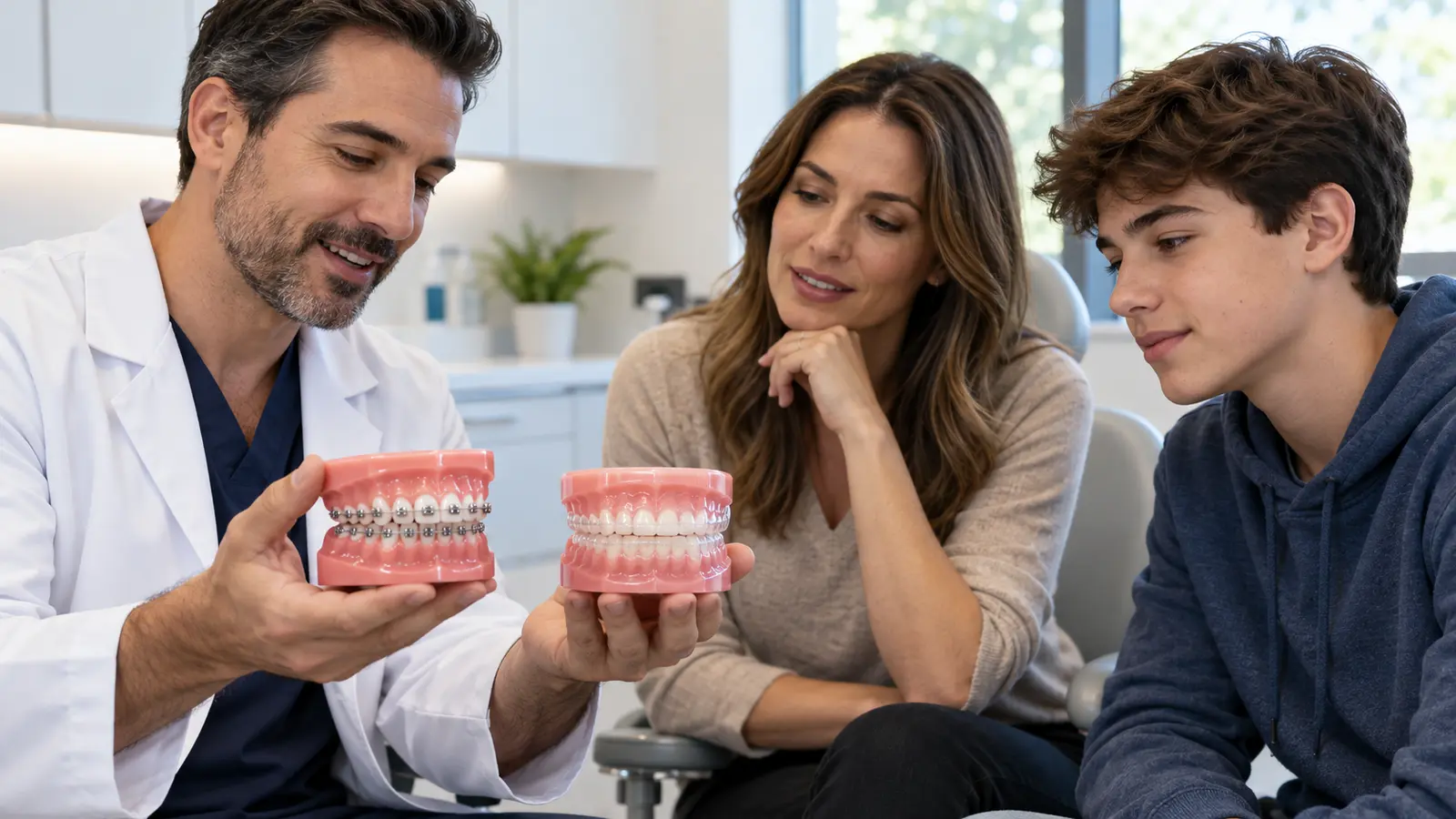
Most people arrive at this decision the same way: they know they want straighter teeth, they’ve heard of both options, and they’re not sure which one actually fits their life. The honest answer is that both Invisalign and traditional braces work. The Canadian Dental Association recognizes both as effective orthodontic treatments for a wide range of alignment issues. What separates them is not effectiveness, but how they fit into your daily routine, your budget, and the movement your teeth need.
This guide lays out the real differences so you can walk into a consultation already knowing what to ask — without being pushed toward either option.
Quick Takeaways
- Both treatments achieve comparable results for mild to moderate cases; the choice comes down to lifestyle and case complexity.
- Invisalign in Oakville typically runs $4,500 to $8,000; traditional braces range from $3,500 to $7,000.
- Ontario’s OHIP does not cover orthodontics. Private insurance may cover 50% up to a $1,500 to $3,000 lifetime maximum, for either option.
- Invisalign requires 20 to 22 hours of daily wear; skipping that commitment extends treatment or compromises results.
- Complex cases involving significant crowding or jaw movement often respond better to fixed braces.
- A clinical assessment is the only way to know which option your teeth actually need.
The Side-by-Side: What Actually Differs Between the Two
Before getting into who each option suits, here’s how they stack up across the factors that matter most to most patients.
| Factor | Invisalign | Traditional Braces |
| Appearance | Nearly invisible clear aligners | Metal or ceramic brackets, visible |
| Oakville Cost Range | $4,500 to $8,000 | $3,500 to $7,000 |
| Typical Timeline | 12 to 18 months (simple to moderate cases) | 18 to 24 months (most cases) |
| Maintenance | Remove to eat and brush, then clean aligners daily | Fixed in place, so brushing around brackets takes more care |
| Food Restrictions | None (aligners come out) | Avoid hard, sticky, or chewy foods |
| Office Visits | Every 6 to 8 weeks; roughly 30% fewer appointments | Every 4 to 6 weeks for adjustments |
| Candidacy | Mild to moderate crowding, spacing, and bite issues | Mild to severe; handles complex root movement well |
| Teen Suitability | Works well for motivated, responsible teens | Reliable regardless of compliance |
| Insurance Treatment | Covered under orthodontic benefits on most plans | Covered under orthodontic benefits on most plans |
The cost gap is real but narrowing. For comparable cases in the Oakville and Greater Toronto Area market, the price difference between Invisalign and braces has shrunk considerably. The overlap is significant enough that cost alone shouldn’t drive the decision for most families.
A Note on Timeline
The 2024 comparative data shows Invisalign averaging around 18 months for teens and straightforward adult cases, versus roughly 24 months for braces. That six-month difference holds for moderate cases. It flips for complex ones: cases requiring extraction or significant arch movement can take longer with aligners than with fixed appliances.
Not sure which category your case falls into? The team at Smile Design Dental Care in Oakville offers consultations to assess your teeth and walk you through realistic timelines for both options. Book a time online or call 905-582-8558.
Who Invisalign Actually Suits
Invisalign works best when the patient’s lifestyle and case complexity align with what the technology does well.
The lifestyle fit
The removable nature of aligners is the biggest advantage and the biggest risk. You can eat whatever you want, brush your teeth normally, and go through most social situations without anyone noticing you’re in treatment. For working adults in professional settings, that discretion matters. For teens who play contact sports or wind instruments, the ability to remove the aligners is genuinely useful.
The catch is that aligners only work when they’re in your mouth. The clinical requirement is 20 to 22 hours of daily wear. Take them out for meals, coffee, and brushing. That’s it. Patients who consistently fall short of that window see their treatment extend or their results suffer.
The clinical fit
Invisalign handles a wide range of cases well:
- Mild to moderate crowding or spacing
- Mild overbite, underbite, or crossbite
- Teeth that have relapsed after previous orthodontic treatment
- Patients with gum sensitivity who find metal brackets irritating
Where it has limits: severe crowding, significant vertical tooth movement (intrusion or extrusion), and complex bite correction involving jaw positioning. A 2025 expert consensus published in the International Journal of Oral Science confirmed that these movements have lower predictability with clear aligners than with fixed appliances.
The real question to ask yourself: will you actually wear them 22 hours a day, every day, for a year or more? If yes, Invisalign is likely a strong fit. If you’re not sure, that hesitation is worth raising with your dentist before you commit.
Who Traditional Braces Actually Suit
Braces have a reputation problem they don’t deserve. Calling them the less sophisticated option ignores what they actually do better.
When braces have the clinical edge
Fixed orthodontic appliances apply continuous pressure around the clock. There’s no compliance variable. The brackets and wires are attached, so the teeth move whether the patient thinks about it or not. That matters in several scenarios:
- Severe crowding (more than 8mm): Only about 37% of Canadian orthodontists feel comfortable treating severe crowding with clear aligners, according to survey data from the orthodontic community.
- Complex bite correction: Cases requiring significant vertical movement or jaw repositioning are more predictably managed with fixed appliances.
- Younger teens with variable motivation: A 14-year-old who loses interest in wearing their aligners by month three is a real scenario. Braces remove that variable entirely.
- Cases requiring tooth extraction: When teeth need to be removed as part of treatment, braces typically guide the remaining teeth more efficiently.
The lifestyle trade-offs
Braces are visible. That’s the primary objection most adults have, and it’s a legitimate one. Ceramic (tooth-coloured) brackets reduce the visual impact considerably, though they cost slightly more than standard metal.
Food restrictions are real: hard foods like raw carrots, sticky foods like caramel, and anything that could snap a bracket off need to be avoided for the duration of treatment. Oral hygiene takes more effort, brushing around brackets requires technique and time.
The upside: you never have to remember to put anything back in. Once braces are on, the treatment is running continuously. For patients who know themselves well enough to predict they’d struggle with aligner compliance, that reliability is worth the trade-offs.
What Ontario Insurance Actually Covers (and What It Doesn’t)
Ontario orthodontic coverage is more complicated than most people expect, and finding out after you start treatment is the worst time to learn that.
The baseline reality: OHIP does not cover orthodontic treatment for adults or teens in routine cases. Coverage comes entirely from private employer-sponsored dental plans, if your plan includes it.
How most Ontario dental plans handle orthodontics
Most employer dental plans that include orthodontic benefits work like this:
- Coverage rate: Roughly 50% of the total treatment cost, up to a lifetime maximum
- Lifetime maximum: Typically $1,500 to $3,000 per insured person, a one-time limit that applies across your entire time with that plan
- Age restrictions: Many plans cover dependents under 18 or 19; adult orthodontic coverage is less common and varies by employer plan
- Pre-authorization: Most insurers require a treatment plan and cost estimate before you start; skipping this step can result in a denied claim
Does insurance cover Invisalign the same as braces?
Usually, yes. Most Canadian group dental plans apply the same orthodontic lifetime maximum to both braces and Invisalign. The difference in what you pay out of pocket comes from the total fee your provider charges, not from the insurance formula itself.
The exception: some insurers classify Invisalign as a cosmetic procedure rather than medically necessary orthodontics. If your plan’s wording specifies coverage only for “metal or fixed orthodontic appliances,” clear aligners may be excluded. Plans introduced after 2020 more commonly include clear aligners under their orthodontic benefits, particularly when supported by a pre-authorization from your treating dentist.
The practical step: Before booking a consultation, pull out your benefits booklet and look under “orthodontics” or “major services.” Confirm your lifetime maximum, the coverage percentage, and whether the plan specifies age limits or appliance type. The Ontario Dental Association recommends getting a pre-determination from your provider before any major treatment begins.
For a mid-range Invisalign case in Oakville at $6,000, a plan covering 50% up to a $2,500 maximum would leave you paying roughly $3,500 out of pocket. Payment plans spread that cost across the treatment period, which most clinics offer as standard.
Is Invisalign as effective as braces?
For mild to moderate cases, yes. A 2024 comparative study found Invisalign corrected malocclusion successfully in 88% of cases versus 90% for traditional braces — a difference that was not statistically significant. For complex cases involving severe crowding, extraction, or significant vertical movement, braces tend to be more predictable.
How much does orthodontic treatment cost in Oakville?
Invisalign in Oakville typically ranges from $4,500 to $8,000 depending on case complexity and treatment length. Traditional metal braces run from $3,500 to $7,000, with ceramic (tooth-coloured) braces sitting slightly higher. These ranges reflect the Greater Toronto Area market, where prices run 10 to 20% above the national average. The only way to get an accurate number for your specific case is through a clinical assessment.
My teen wants Invisalign. Should I say yes?
It depends on the teen. Invisalign Teen works well for patients who are genuinely motivated and responsible enough to wear the aligners 20 to 22 hours a day. If your teen is the type to lose things, forget routines, or is easily distracted by social situations where they’d want the aligners out, braces are a more reliable choice. This is worth discussing honestly at a consultation rather than making assumptions.
Can adults get braces in Ontario?
Yes, and more adults are choosing orthodontic treatment than ever before. The clinical process is the same as for teens; the main differences are that adult bone density can mean slightly slower tooth movement in some cases, and that many employer dental plans have age restrictions on orthodontic coverage. Confirm your plan details before starting.
Do I need a referral to see an orthodontic provider in Oakville?
No referral is required. You can book a consultation directly with a dental provider who offers orthodontic services. At that appointment, the dentist will assess your teeth, review X-rays, and give you a clear recommendation on which treatment suits your case.
What happens after braces or Invisalign come off?
Both treatments require a retainer phase to hold your teeth in their new positions. Skipping retainers is the most common reason teeth shift back after orthodontic treatment. Your dentist will prescribe either a fixed (bonded) retainer, a removable retainer, or both, depending on your case.
Ready to Find Out Which Option Fits Your Teeth?
The right choice depends on your teeth, your habits, and your budget. This guide gets you oriented, but the only way to know for certain is to have a dentist look at your actual teeth.
The team at Smile Design Dental Care in Oakville offers orthodontic consultations. You’ll get a clinical assessment, a clear explanation of what your case requires, and honest guidance on which option fits your situation — without pressure toward either one.
Book your consultation online or call 905-582-8558 to get started.