
Pediatric Dentist vs Family Dentist: Which Is the Better Choice for Your Kids in Oakville?
Your child’s first dental appointment is coming up. Maybe you’ve just moved to Oakville and you’re setting up a new dentist for the whole family. You’ve seen the term “pediatric dentist” and you’re wondering whether kids actually need a specialist or whether a good family dentist is enough.
The honest answer: most children do perfectly well with a family dentist who welcomes young patients. A pediatric dentist, a formally trained specialist credentialed by the RCDSO (Royal College of Dental Surgeons of Ontario), is genuinely the better choice for a specific set of children.
Is It Better to Take Your Child to a Pediatric Dentist or a Family Dentist?
Quick answer is: For most healthy children in Oakville, a family dentist provides excellent routine care including cleanings, X-rays, fillings and preventive guidance from the first tooth through adolescence. A certified pediatric dentist, who holds a specialist designation from the RCDSO (Royal College of Dental Surgeons of Ontario) after two to three additional years of training, is the better choice for children with high dental anxiety, special health needs or complex cases requiring advanced sedation.
What Is the Difference Between a Pediatric Dentist and a Family Dentist?
Both start from the same place: a four-year dental degree from an accredited university. After that, the paths separate.
A pediatric dentist continues into a two to three year post-graduate residency covering child psychology, behaviour management, growth and development of primary and mixed dentition, care for children with special health needs and advanced sedation techniques. In Ontario, completing this residency and passing the national specialty examination earns a specialist designation from the RCDSO. This is sometimes called the “two-year rule”, the additional training that separates a general dentist from a certified pediatric specialist.
A family dentist, after earning their dental degree, enters general practice. Some complete an optional one-year general practice residency. They are fully licensed to treat children and many spend a meaningful part of their career doing exactly that, without holding a specialist credential.
For a healthy six-year-old at a routine cleaning, this distinction in credentials rarely changes the quality of care. For a three-year-old who needs multiple fillings under sedation, it matters significantly.
Should Every Child See a Pediatric Dentist?
No, a lot of Oakville parents will be surprised to hear that said plainly.
Pediatric dental offices are purpose-built for younger patients: child-sized instruments, bright décor, staff trained exclusively in child behaviour management and a schedule built around children’s attention spans. For a nervous child, that environment helps. For a cooperative child with standard dental needs, it is an added layer that may not be necessary and often comes at a higher cost. Learn more about family dental care for children in Oakville.
Lifelong Continuity.
Your child sees the same dentist from their first tooth through adulthood. No transition out of a pediatric practice at 17 or 18, no restarting the relationship with a new team.
Whole-Family Efficiency.
One appointment block, one location, one set of records. If you live in West Oak Trails or Iroquois Ridge and your evenings are already full, getting the whole family seen on the same visit matters.
Cost Alignment.
Pediatric specialist offices typically follow a specialist fee schedule. A family dentist who follows the ODA (Ontario Dental Association) general fee guide provides the same preventive services for most children at a comparable or lower cost.
Orthodontic Continuity.
Many family practices also offer Invisalign or braces. If your child will need orthodontic treatment in a few years, a family dentist can manage that transition without sending you to a third practice.
The question is not which type of dentist is inherently better. It is what your specific child needs.
When Does a Child Genuinely Need a Pediatric Specialist?
There are four clear situations where a pediatric specialist’s training makes a clinical difference:
1. Children under three with significant decay — Very young children with multiple cavities often need treatment under sedation or general anaesthesia. In Ontario, only RCDSO-registered specialist dentists can administer advanced sedation to children under 13. A family dentist who identifies this situation will refer to a specialist for that specific treatment.
2. Children with special health care needs — Children with autism spectrum disorder, Down syndrome, cerebral palsy or other conditions that affect behaviour and communication during dental visits benefit from the specialist’s extended behaviour management training and sedation toolkit.
3. Children with diagnosed dental phobia — Mild anxiety is common and manageable at a family practice using the Tell-Show-Do method. True phobia, where a child cannot tolerate treatment despite calm, consistent appointments, is better addressed with a specialist’s full behaviour management toolkit.
4. Complex developmental cases — Children with unusual eruption sequences, severe crowding requiring early intervention or conditions affecting jaw development may benefit from a specialist’s deeper knowledge of pediatric growth patterns.
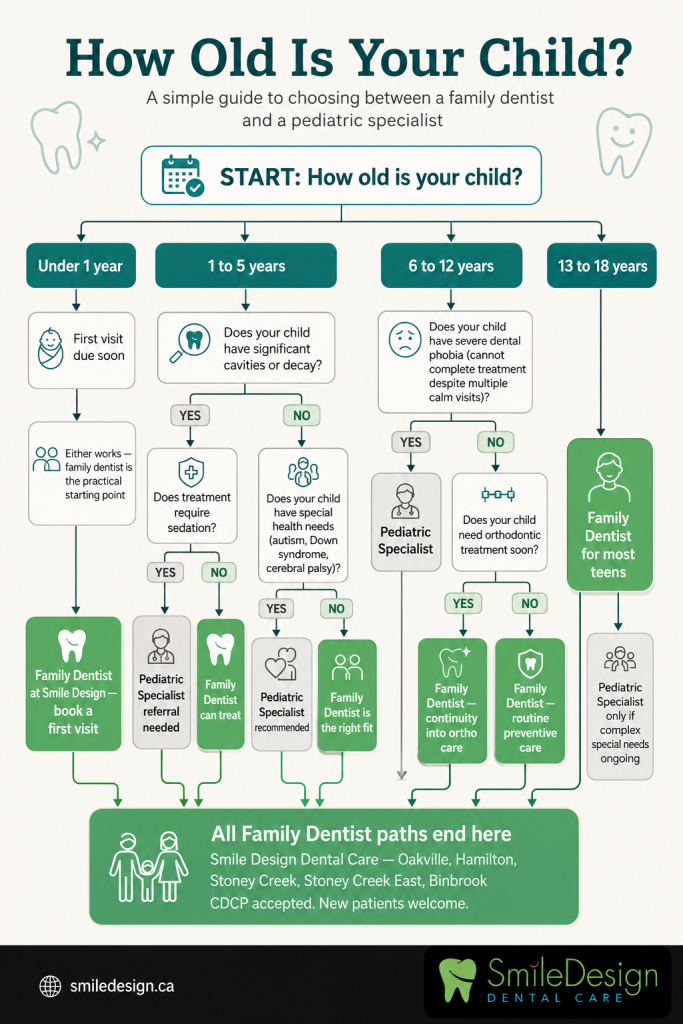
For everything else — cleanings, X-rays, fluoride, sealants, simple fillings, space maintainers, habit counselling for thumb-sucking or teeth grinding — a capable family dentist handles it well.
What to Expect at Your Child’s First Dental Visit
The Canadian Dental Association recommends a child’s first visit happen by the time their first tooth appears or by their first birthday, whichever comes first. At Smile Design Dental Care’s Oakville location on Lakeshore Road West, we start seeing children at age one.
That first appointment is deliberately low-key. Here is what typically happens:
- Warm welcome — Your child sits with you in the chair or on your lap. Nothing unexpected happens without a gentle explanation first.
- Brief examination — We count the teeth that have come in, check the gums and look at how the bite is developing.
- Quick clean — For very young children, this is a light polish and a fluoride varnish application, done in under two minutes.
- Home care guidance — We walk you through the right toothpaste amount for your child’s age and what to expect as more teeth arrive.
- Your questions — This is the time to ask anything about feeding habits, thumb-sucking or the timeline for permanent teeth.
Most children under three are perfectly comfortable by the end of that first visit. Showing up early and often is what builds the foundation.
Does the CDCP Cover Children at a Family Dentist?
Yes, this is a question many Oakville families do not think to ask until they are already at the desk.
The Canadian Dental Care Plan (CDCP) covers children under 18 from families with an adjusted net income under $90,000 who have no private dental insurance. According to Health Canada, online applications for children under 18 opened in June 2024. Covered services include exams, X-rays, cleanings, fluoride treatments, fillings and extractions.
CDCP coverage applies at both family dental practices and specialist offices, as long as the provider is enrolled in the plan. Smile Design Dental Care accepts the CDCP at all five Ontario locations — Oakville, Hamilton, Stoney Creek, Stoney Creek East and Binbrook. For eligible families, we bill Sun Life directly on your behalf.
The practical implication for parents: a strong family dentist enrolled in the CDCP can cover most of your child’s preventive and restorative dental care at little or no out-of-pocket cost, depending on your household income.
Comparison: Pediatric Dentist vs Family Dentist for Children
| Feature | Pediatric Dentist (RCDSO Specialist) | Family Dentist |
|---|---|---|
| Additional post-graduate training | 2–3 years residency required | Optional 1-year GPR only |
| RCDSO specialist designation | Yes | No |
| Treats adults | No | Yes |
| Child-only office environment | Yes | Varies by practice |
| Tell-Show-Do behaviour technique | Standard practice | Available at child-welcoming practices |
| Sedation for children | Advanced sedation for children under 13 (RCDSO licensed specialists only) | Nitrous oxide and standard sedation available — advanced sedation for under-13s requires specialist referral |
| Continuity into adulthood | No — patient transitions out at 18 | Yes — lifelong relationship |
| Typical fee schedule | Specialist fee guide (higher) | ODA general fee guide |
| CDCP accepted | Varies by practice | Yes — at all five Smile Design Ontario locations |
| Orthodontic services | No | Yes — Invisalign and braces available |
| Thumb-sucking and habit guidance | Yes — specialist training | Yes — routinely addressed |
| Best suited for | High-anxiety, complex needs, young children requiring advanced sedation | Most healthy children; families wanting one-stop, lifelong care |
At What Age Should a Child Stop Seeing a Pediatric Dentist?
Most pediatric practices treat children up to age 18. Some extend that for patients with special health needs who benefit from continuity with a familiar team. In practice, many Ontario families transition to a family dentist around age 12 to 14, once the permanent dentition is largely established.
If you’re making that transition, ask the pediatric practice for a handover summary: current dental history, ongoing concerns, any treatments in progress. A good pediatric dentist will have this ready without being asked.
If your child started with a family dentist from the beginning, there is no transition to manage. The relationship simply continues.
Can a Family Dentist Treat Baby Teeth?
Yes, fully. Baby teeth, primary teeth, are entirely within a general dentist’s scope of practice. Family dentists fill cavities in primary teeth, extract teeth that won’t fall out naturally, place space maintainers and monitor the eruption of permanent teeth to catch crowding early.
At Smile Design Dental Care, we see children as young as one year old across all our locations. The first visit is short, low-key and entirely about getting your child comfortable in the chair before anything clinical needs to happen.
Frequently Asked Questions
What is the 2-2-2 rule in dentistry?
The 2-2-2 rule is a simple preventive framework: brush twice a day, for two minutes each session and visit your dentist twice a year. For children, use a rice-grain smear of fluoride toothpaste under age three and a pea-sized amount from age three to six. The nighttime brushing session is the most important because saliva production drops overnight.
What is the 3-3-3 rule in dentistry?
The 3-3-3 rule is an extended oral hygiene framework used in some pediatric settings: brush three times daily (morning, after school and before bed), for three minutes per session, following a three-step routine of brush, floss and rinse. It is typically recommended for children with higher cavity risk or those in orthodontic treatment, not as the standard starting point for all children.
What is the difference between a pediatric dentist and a family dentist?
A pediatric dentist in Ontario is an RCDSO-recognized specialist who has completed two to three years of post-graduate residency in children’s oral health, including behaviour management, sedation and developmental dentistry. A family dentist holds a general dental degree and treats patients of all ages. Both can treat children; the specialist’s training matters most for complex or high-anxiety cases.
At what age should a child stop seeing a pediatric dentist?
Most pediatric practices treat patients up to age 18. Many Ontario families transition to a family dentist around age 12 to 14, once permanent teeth are established. Children who started with a family dentist from infancy need no transition at all, they stay with the same practice throughout their life.
Does the Canadian Dental Care Plan cover children at a family dental office in Ontario?
Yes. The CDCP covers children under 18 from families with adjusted net income under $90,000 who have no private dental insurance. Coverage applies at both family dental and specialist practices enrolled in the plan. Smile Design Dental Care accepts CDCP at all five Ontario locations and bills Sun Life directly on behalf of eligible patients.